What is left of me?
A different way to think about human value, beyond what machines can do faster or what can be reduced to a metric.
THE NEW BOOK · STORY.ONE
With Viktor Frankl, Serenely Through the Age of AI
What remains uniquely human when machines can do more and more? A personal essay on AI, meaning, and the choices we should never delegate.
English hardcover available to order at Thalia.
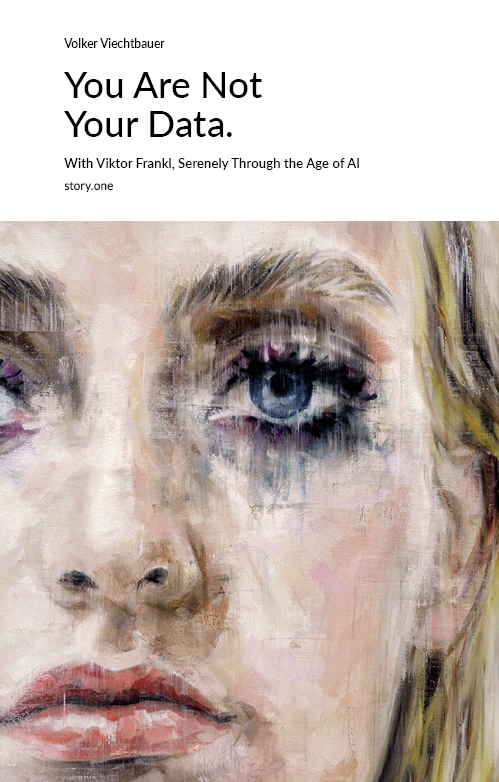 Book cover currently unavailable
AT THE HEART OF THE BOOK
AI can write, calculate, and give us answers. But who checks them? Who chooses? Who takes responsibility? Volker Viechtbauer explores the things we should not hand over to a machine.
A different way to think about human value, beyond what machines can do faster or what can be reduced to a metric.
Where AI can help and why judgment, selection, and responsibility still have to remain ours.
Viktor Frankl as a starting point for thinking about meaning, beyond performance, optimization, and perfect profiles.
READING SAMPLE
Chapters 1 and 2. Read right here.
I wrote this book out of fear. And I believe you know this fear too. It is not the fear of the headlines: that artificial intelligence takes our jobs away – a worry I would not talk anyone out of – or overtakes us and one day seizes world domination, even destroys us. Much of that is still science fiction. My fear is a different one, quieter, perhaps more justified: that we are already in the process of abolishing ourselves, before AI has even tried.
Early September 2026, and DIE ZEIT lies on my breakfast table, open at the Streit page, the paper’s debate section. At the top, a sentence from Helmut Schmidt: “A democracy in which nobody argues is not one.” Beneath it the question: Will AI save our prosperity? On the left Karsten Wildberger, Germany’s minister for digital affairs, suit, gestures, manager. His recipe is speed: “Whoever does not use AI, or uses it far too hesitantly, is choosing job destruction all the more surely.” On the right Yasmin Fahimi, head of the German Trade Union Confederation: “Unfortunately, what I see in the companies is great uncertainty about how they should use AI.”
Both are right. And both fall short. One says: let the technology grow wild, and growth will come. The other: distribute the yield fairly, and justice will come. Neither asks: what does this do to the human being? Prosperity without dignity is merely well-paid meaninglessness. The question is not whether AI saves our prosperity. It is whether we save our meaning. And behind it stands the question: if the machine can do everything I can do, only faster, cheaper, with fewer errors – what is left of me? For years I have been setting two concepts side by side that occupied Viktor Frankl all his life: self-actualization and self-forgetfulness. In my lectures I like to look at them in three dimensions: worldview, image of man, entrepreneurial spirit. Self-actualization plays a major role in our time. Measure yourself. Optimize yourself. Actualize yourself.
This total self-actualization has three faces. In China I see the first: the total measuring of the human being, the person as a data point with a score. In America the second: self-optimization as the American journalist Barbara Ehrenreich describes it in Bright-Sided – the navel-gazing of positive psychology, with Martin Seligman as its figurehead. And most recently, from the opposite direction, a Catholic integralism around figures such as the Harvard law professor Adrian Vermeule and J. D. Vance that wants to put the free conscience back under guidance – not only technically but theologically. And everywhere the third: AI. It is not our enemy; it is a tool, and whoever wields it decides what for: it supplies the one with the technology of control, the other with the perfect narrative – and us in the West with the illusion that we are actualizing ourselves while we are merely measuring and marketing ourselves. Three faces, one promise: a life in which the choice is taken from us.
This book is about Viktor Frankl because he lived the answer to this fear. Frankl, who was born in Vienna in 1905 and died there in 1997, was a neurologist and psychiatrist. After Freud’s psychoanalysis and Adler’s individual psychology, he founded the third Viennese school of psychotherapy, logotherapy: a healing art that understands the human being not from his drives but from his will to meaning. His account of the camps, …trotzdem Ja zum Leben sagen – “…nevertheless, say yes to life” – became, as Man’s Search for Meaning, one of the most influential books in America.
In Auschwitz he experienced what happens when a human being is nothing but a number. He survived – by luck, as he himself never failed to say. But what kept him alive inside was the opposite of the number: he forgot himself. He thought of his manuscript The Doctor and the Soul, which he lost on arrival in Auschwitz, sewn into the lining of his coat, and later reconstructed from memory on scraps of paper in the Türkheim camp, to keep himself mentally alive through typhus. He thought of the lecture he would one day give about it at the adult education center, and of his beloved Rax mountain; he thought of a meaning outside himself. He called this self-transcendence – and what held him up inside, the defiant power of the human spirit.
So if you are afraid of the future, you are right. But this fear is no reason for resignation. It is the proof that your conscience is still alive. I hope you will read this book with that defiant power.
Reading excerpts from the supplied chapter material; not checked against the final print edition. English reading sample translated from the German manuscript; not a published English edition.
I published my last book three years ago. It was written entirely without AI, and I worked on it for years. This book is being written with AI. I bring in my thoughts, my material, my selection, and I edit what the machine builds from them. By the morning of September 8, 2026, Hannes Steiner and I had put twelve hours of work into this book. After seven days the manuscript was there. Seven days against years of work. It is the attempt to publish Viktor Frankl’s thoughts on a current topic while it is still current.
That is frightening. Because it is possible. And because it is brutally efficient. Still, the calculation is only half honest: the seven days stood on more than five years of work on my last book and on decades of thinking with Frankl. The machine shortened the writing. It did not shorten the thinking. I do not want to spare you this fright, because it is part of the subject: here is someone warning against the comfortable handover of thinking – with a tool that offers precisely this comfort.
But we are not the first to fear that a new technology could replace our thinking. In the dialogue Phaedrus, Plato has Socrates tell the myth of Theuth. Theuth, the Egyptian god, invents writing and proudly brings it to King Thamus: a remedy for memory and wisdom. Thamus answers: you have invented the opposite. Writing will bring forgetfulness into souls; trusting external signs, people will let themselves be reminded from outside instead of remembering from within. They will have the appearance of wisdom, not wisdom itself. And writing does not answer: if you ask it, it is silent, it always says the same thing. Replace the word writing with AI, and you have today’s debate.
Socrates feared that writing would replace memory. We feared that Google would replace knowledge. Today we fear that AI will replace thinking. Each time the same thing happened: the technology did not abolish the human being, it forced him to climb one step higher. From memorizing to understanding. From knowing to judging. Today it forces us from judging to finding meaning. No machine can do that. Times of upheaval have always had fast, short texts. Even the main work of the Enlightenment, the Encyclopédie of Denis Diderot and Jean-Baptiste d’Alembert (1751–1780, 35 volumes), was at its core a collection of more than 70,000 short articles, from Voltaire to Rousseau; it appeared volume by volume, against censorship and prohibition, and condensed what lay scattered in writings, workshops and heads.
The same principle – first the fast text, then the book – shows in Alphonse Daudet, who as a chroniqueur for Le Figaro and other papers wrote feuilletons such as the Letters from My Windmill, which later appeared as a book. Kant’s answer to the question of what enlightenment is appeared in December 1784 in the Berlinische Monatsschrift – fourteen pages, a journal article, not a book. Thomas Paine’s Common Sense came out on January 10, 1776, as a pamphlet of forty-seven pages; only three days later a letter reports lively demand. And in that very essay Kant names the convenience of handing one’s understanding over to a book and one’s conscience to another person. That was no prediction of AI. But today it reads like the sharpest description of what threatens us when we delegate judgment.
Whoever now accuses me of contradiction – the man writes with the machine against the machine – is right as far as the contradiction goes. I only draw a different conclusion from it. AI exists, whether we like it or not. Not to use it would be a mistake. To use it as if it were the author would be a bigger one. This book is therefore not an AI book. It is a book about AI – written with AI, against AI and with the help of AI. In the following pages you will see where the difference lies, and you may hold me to it. The machine delivered the linguistic material and the diction. The cause – ideas and content – was set by me.
Reading excerpts from the supplied chapter material; not checked against the final print edition. English reading sample translated from the German manuscript; not a published English edition.

“The machine shortened the writing. It did not shorten the thinking.”
From the book · Chapter 2 · p. 13 · English translation
LISTEN TO THE BOOK
Chapters 1 + 2. In German and English.
Audio excerpt
Loading audio excerpt for seeking …
The recording could not be loaded. Please try again.
THE AUDIOBOOK · COMING SOON
The audiobook is coming soon to the following platforms.
 Apple MusicLogo currently unavailable
 ThaliaLogo currently unavailable
 AudibleLogo currently unavailable
 SpotifyLogo currently unavailable
EXPERIENCE THAT SHAPES THE PERSPECTIVE
Volker Viechtbauer’s perspective on AI grows out of years of responsibility across legal affairs, HR, leadership, and organizational culture, alongside a long engagement with Viktor Frankl’s work.

Press comment on the earlier book · translated from German
“The book brings entrepreneurial history and philosophy together in a unique (indeed, uplifting) whole.”
Ulli Wright · Die Oberösterreicherin · 28.11.2023
MAKE IT YOUR NEXT READ
Discover the English hardcover edition of You Are Not Your Data.
Book cover currently unavailableVolker Viechtbauer
For interviews, readings and questions about the book.
Press materials